The Missing Definition: Why We've Never Actually Defined Work
A Position Paper on Work Codex and the Four-Dimensional Ontology of Work

The Problem No One Named
For over a century, management theorists, economists, philosophers, and organizational scientists have studied work. They've measured it, optimized it, redesigned it, and debated its meaning. What none of them did was define it.
This isn't a rhetorical claim. It's a structural observation about the intellectual history of work itself.
Frederick Taylor studied tasks. Peter Drucker studied knowledge workers. Hannah Arendt distinguished labor from work from action. The International Labour Organization defined work so broadly — "any activity performed to produce goods or services" — that the definition operationalizes nothing. Activity-Based Working, the dominant workplace design philosophy of the past decade, defines work as activities requiring different spatial settings.
Each framework captured something real. None captured work itself.
The result is a fractured landscape where HR measures engagement through surveys, Real Estate measures utilization through sensors, IT measures technology adoption through licenses, and Operations measures time through schedules. Four functions. Four measurement systems. Four partial views. Zero synthesis.
This paper argues that Work Codex represents the first complete ontology of work — not merely a new measurement approach, but a foundational definition that makes comprehensive measurement possible for the first time.
A Brief Taxonomy of Incomplete Definitions
Taylor (1911): Work as Tasks
Scientific Management defined work as discrete, time-measurable tasks that could be decomposed into atomic units, observed, optimized, and standardized. Taylor's contribution was methodological rigor applied to physical labor. His limitation was treating work as something done to workers rather than by them, and capturing only the task dimension while ignoring context, collaboration, and cognition.
Marx (1844): Work as Species-Being
Marx defined work as the essential expression of human nature — the means by which we transform nature and realize ourselves. Under capitalism, this becomes "alienated labor," estranged from product, process, fellow humans, and self. Marx's contribution was recognizing work's existential significance. His limitation was philosophical abstraction — he described the relationship between worker and production, not work itself as an observable phenomenon.
Arendt (1958): Labor, Work, and Action
Hannah Arendt distinguished three categories of human activity: labor (biological necessity, cyclical, consumed), work (creating durable objects that build a shared world), and action (speech and interaction in the public realm). Her contribution was categorical precision. Her limitation was taxonomy without integration — she distinguished types of activity but didn't describe how they interact or could be measured in practice.
Drucker (1959): Work as Knowledge Application
Drucker defined knowledge work as "thinking for a living" — applying theoretical and analytical knowledge to produce goods and services. The knowledge worker manages themselves, innovates continuously, and represents an asset rather than a cost. His contribution was recognizing the cognitive shift in modern economies. His limitation was single-dimensional focus — he described who does work and how (via knowledge), but not where work happens or the contextual factors enabling it.
ILO (2013): Work as Activity
The International Labour Organization formally defined work as "any activity performed by persons of any sex and age to produce goods or to provide services for use by others or for own use." This is the broadest possible definition. It captures everything and operationalizes nothing. It cannot distinguish contexts, modes, or enabling conditions.
Activity-Based Working (1980s–Present): Work as Spatial Requirement
Robert Luchetti and later Veldhoen + Company defined work through the lens of activities requiring different environmental settings — focus work, collaboration, creative thinking, team coordination, and discussion. Space should match activity. This framework dominates contemporary workplace design. Its contribution is recognizing that different work modes require different physical contexts. Its limitation is
Place-centricity — it assumes work is defined by spatial requirements while ignoring temporal patterns, technology integration, and cross-functional synthesis.
The Pattern of Partiality
What emerges from this history is not intellectual failure but disciplinary constraint. Each thinker defined work from their vantage point:
| Framework | Primary Dimension | Blind Spots |
|---|---|---|
| Taylor | Task (Activity) | Context, autonomy, collaboration |
| Marx | Production relationship | Operational measurement |
| Arendt | Activity categories | nIntegration, measurement |
| Drucker | Cognitive process | Place, Time, Technology |
| ILO | Broad activity | Specificity, context |
| ABW | Place-Activity match | Time, Technology, synthesis |
The organizational functions that inherited these frameworks replicated their partiality:
- Human Resources adopted engagement and activity frameworks—surveys, pulse checks, performance reviews
- Corporate Real Estate adopted spatial frameworks—utilization studies, occupancy sensors, space planning
- Information Technology adopted technology frameworks—adoption metrics, license utilization, digital workplace tools
- Operations adopted temporal frameworks—scheduling, capacity planning, workforce management
Each function optimized its dimension. None could see the others. The enterprise had no unified view of work itself.
Work Codex: The Four-Dimensional Ontology
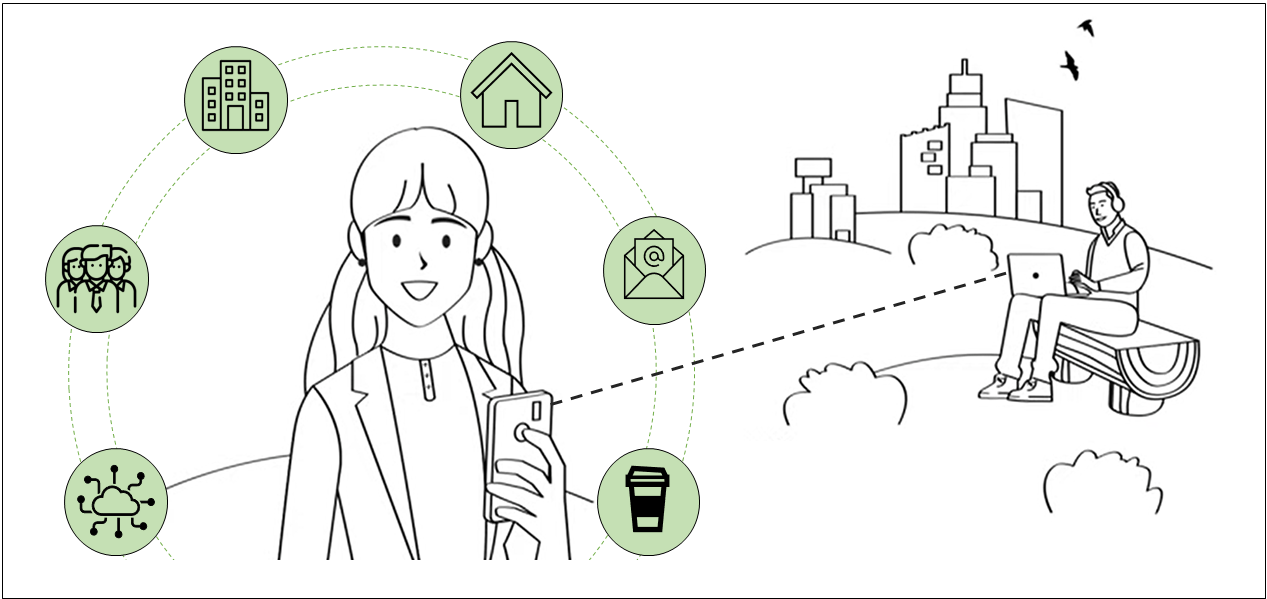
Work Codex proposes that work is not a task, not a knowledge process, not a spatial activity, and not a temporal allocation. Work is the interaction across four dimensions:
- Places — Where work happens: office, home, client site, third space, in transit
- Activities — What work involves: collaboration, focus, communication, creation, coordination
- Time — When and how long work occurs: synchronous, asynchronous, scheduled, emergent, sustained, fragmented
- Technology — What tools mediate work: communication platforms, productivity software, enterprise systems, physical equipment
This is not a measurement framework imposed on work. It is a definition of what work is. Work exists at the intersection of these four dimensions. A meeting is not merely an Activity—it is an Activity occurring in a Place, at a Time, mediated by Technology. Change any dimension and you change the work itself.
The PATT framework (Places, Activities, Time, Technology) is therefore not an analytical overlay but an ontological claim: work that cannot be located across all four dimensions is incompletely described.
Why This Matters: The Cross-Dimensional Leak
The practical consequence of partial definitions is partial visibility. And partial visibility produces systematic leakage.
Consider the widely-documented costs of workforce dysfunction:
- Turnover: Average replacement cost of $48,000+ per knowledge worker (SHRM, Bureau of Labor Statistics: this we believe is significantly under-represented)
- Underutilized space: 30-50% of commercial real estate sits empty on any given day (CBRE, JLL industry benchmarks)
- Collaboration failure: Teams lose 20%+ productivity to coordination friction (McKinsey, Microsoft Work Trend Index)
- Technology friction:
Workers lose 3+ hours weekly to tool-switching and system friction (Asana, RescueTime studies)
These are not four separate problems. They are four symptoms of one problem: work is breaking down at the intersections of dimensions that no single-dimension tool can see.
A conference room showing 40% utilization (Place data) might host the highest-collaboration teams in the organization (Activity data) during their most productive hours (Time data) while failing because of hybrid meeting technology mismatch (Technology data). Single-dimension analysis recommends eliminating the room. Four-dimensional analysis reveals the room is critical infrastructure being undermined by a Technology gap.
The leak isn't in any single dimension. It's in the seams between them. And it compounds to approximately $72,000 per employee annually across the average knowledge workforce—a figure derived from synthesis of Bureau of Labor Statistics turnover data, Gallup engagement studies, SHRM replacement cost research, and commercial real estate utilization benchmarks. This leak was always there. We simply lacked the language (and rigorous overlay) to be able to clearly see it and take appropriate actions.
From Measurement to Definition
The distinction between Work Codex and prior frameworks is not methodological but ontological.
Activity-Based Working asks: "What spaces do different activities require?"
Work Codex asks: "What is work, such that it can be comprehensively observed and optimized?"
The answer—interaction across Places, Activities, Time, and Technology—enables measurement approaches that were previously impossible. Not because the data didn't exist, but because no framework existed to capture it, organize and then synthesize response.
Organizations already capture Place data (badge swipes, sensors, room bookings), Activity data (calendar patterns, collaboration tools, project management systems), Time data (schedules, meeting duration, work hours), and Technology data (application usage, system logs, tool adoption). What they lack is a unifying ontology that makes these four data streams legible as a single phenomenon: work.
Work Codex provides that ontology. The PATT framework is the grammar. Cross-dimensional pattern recognition is the syntax. Behavioral intelligence—understanding not just what happened but why, and what intervention would improve outcomes—is the semantics.
Implications for Practice
If work is four-dimensional interaction, several practical implications follow:
1. Single-dimension optimization is structurally limited.
Utilization studies cannot solve engagement problems. Engagement surveys cannot solve space problems. Technology rollouts cannot solve collaboration problems. Each intervention optimizes one dimension while potentially degrading others.
2. The leak lives in the intersections. The largest performance gaps exist where dimensions meet: Place- Activity mismatches (wrong space for the work), Activity-Time conflicts (collaboration scheduled during focus hours), Time-Technology friction (synchronous tools applied to asynchronous work), and so on. Interventions must target intersections, not dimensions.
3. Visibility must precede strategy. Organizations cannot optimize what they cannot see. Before workplace strategy, before real estate decisions, before technology investments, organizations need four-dimensional visibility into how work actually happens. Codex provides the framework; implementation provides the data; pattern recognition provides the insight.
4. The container is no longer the operating system.
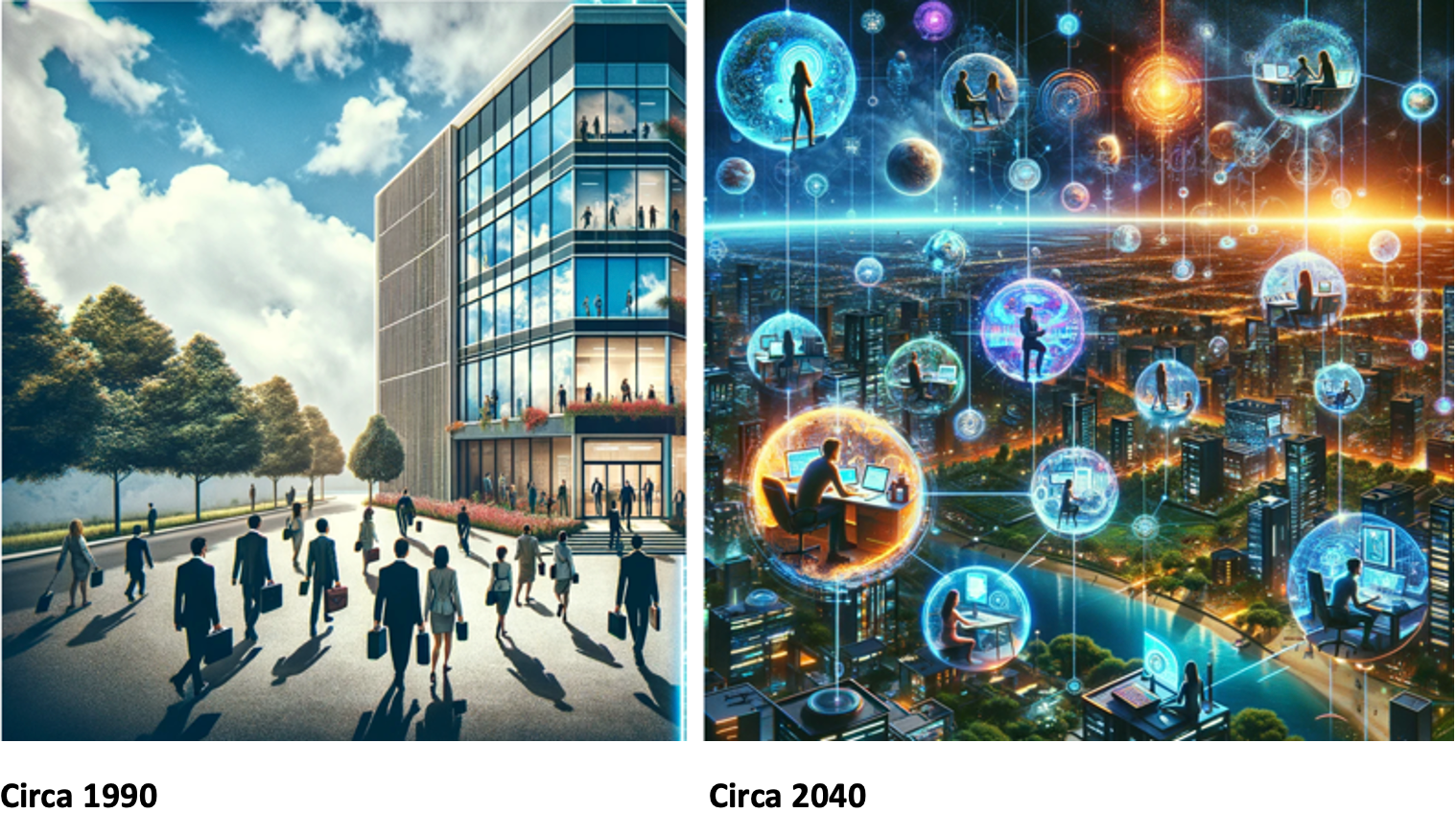
Pre-2020, the physical workplace provided ambient visibility. Managers observed collaboration, identified problems, and sensed the culture by walking the floor. The building was a passive sensing system. That system broke. Remote and hybrid work eliminated ambient visibility without replacing it. Work Codex is the replacement—a deliberate visibility system for a distributed work environment.
Conclusion: Claiming the Definition
Every framework that becomes standard started as one person seeing something others missed. Porter's
Five Forces was "a Michael Porter thing" before it was taught in every business school. Jobs-to-be-Done
was "a Clayton Christensen thing" before it became innovation methodology. The question is never
whether a framework is established—it's whether the logic holds.
Work Codex holds that:
- Work is four-dimensional interaction across Places, Activities, Time, and Technology
- Prior definitions captured single dimensions, producing partial visibility
- Partial visibility enables systematic leakage at dimensional intersections
- That leakage compounds to significant per-employee cost
- Four-dimensional visibility enables diagnosis and intervention impossible under prior frameworks
This is not a product proposal or a technology pitch. It is a definitional claim about the nature of work itself—the first complete ontology in a field that has studied work for over a century without defining it.
The $72,000 leak was always there. We simply needed the language to see it.
Work Codex is that language.