WORK CODEX : A Complete Ontology of Work
The First Comprehensive Definition of What Work Is

1. The Claim
Work has never been defined.
Throughout human history, philosophers, economists, management theorists, and labor organizations have described aspects of work, measured outputs of work, and debated the value of work. None have offered a complete definition of what work is.
This document makes an ontological claim: Work is observable interaction across four dimensions.
These four dimensions are:
Activities — What work is being done
Places — Where work is happening
Time — When work is occurring
Technology — How work is enabled
This is the APTT Framework. Any instance of work—in any era, any industry, any context—can be fully characterized by specifying its position across these four dimensions. No additional dimensions are required. Remove any dimension and the description becomes incomplete.
This is not a model. It is not a framework for analysis. It is a definition—a statement about what work fundamentally is.
2. Prior Approaches
The claim that work has never been defined requires examination of what has been attempted. Many theorists have described aspects of work. None have offered a complete ontology.
2.1 Philosophical Approaches
Hannah Arendt (1958) distinguished between labor, work, and action—labor as biological necessity, work as fabrication that creates durable objects, action as political engagement. This trichotomy illuminates the human condition but offers abstract categories, not observable dimensions. It tells us why humans work, not what work is.
Karl Marx analyzed work as the transformation of nature through human effort, emphasizing its social relations and alienation under capitalism. His contribution was economic and political critique, not ontological definition.
Aristotle
distinguished energeia (activity as its own end) from kinesis (motion toward an external end), classifying work as kinesis. This framing addresses the teleology of action but not its constituent dimensions.
2.2 Management Theory
Frederick Taylor (1911) pioneered scientific management, reducing work to measurable motions and outputs. His framework optimized one dimension—productivity—while ignoring place, time flexibility, and technological enablement as independent variables.
Peter Drucker (1959) defined knowledge work as applying knowledge rather than manual skill. This distinguished a category of work but did not define work itself. Where does knowledge work happen? When? How is it enabled? Drucker's definition is partial.
Henry Mintzberg cataloged managerial roles (interpersonal, informational, decisional) and organizational configurations. These are typologies of management, not ontologies of work.
2.3 Empirical Frameworks
O*NET (Occupational Information Network) provides the most comprehensive catalog of job tasks, skills, and requirements in existence. Yet O*NET describes jobs, not work. It operates at the role level, not the instance level. It is descriptive taxonomy, not ontological definition.
Bureau of Labor Statistics Time-Use Surveys track hours spent in "work" as a single undifferentiated category. This treats work as a block of time rather than a phenomenon with internal structure.
Activity-Based Working (ABW) frameworks categorize space needs by activity type— focus work, collaboration, socialization. ABW is a workplace design methodology, not a definition of work. It addresses one dimension (activities in relation to place) while assuming the others.
2.4 Contemporary Workplace Frameworks
Lynda Gratton's hybrid work framework (2021) maps work across two axes: place (constrained to unconstrained) and time (synchronous to asynchronous). This captures two dimensions while omitting activities and technology. It is partial by design—a diagnostic for hybrid policy, not a complete ontology.
Gensler's Workplace Survey identifies work modes: focus, collaboration, learning, socializing. These are activity categories—a subset of one dimension. The framework informs space design but does not define work.
IDC's Future of Work Framework addresses workspace, workforce, and work culture. These are organizational concerns, not ontological dimensions. The framework guides digital transformation strategy, not definition.
2.5 The Common Gap
Each prior approach contributes insight. None achieves completeness. The pattern is consistent: theorists describe aspects of work—its outputs, its meaning, its social relations, its spatial requirements, its temporal patterns—without synthesizing these into a unified definition of what work fundamentally is.
The APTT Framework addresses this gap by identifying the four dimensions that, together, completely characterize any instance of work. It is not a replacement for prior frameworks but a foundation upon which they can be understood as partial views.
3. The Four Dimensions
Each dimension answers an eternal question about work. The questions do not change. The answers evolve.
3.1 Activities — What Work Is Being Done
The Activities dimension captures the typology of work itself—not specific tasks, but categories of activity distinguished by interaction pattern, formality level, and participant scope.
The eternal question: What is being done?
This question has been asked since humans first coordinated effort. A cave painter asks it. A factory foreman asks it. A knowledge worker asks it. An AI-augmented professional will ask it.
3.2 Places — Where Work Is Happening
The Places dimension captures the physical and virtual locations where work occurs. This extends beyond any binary (office/home, factory/field) to recognize the full spectrum of work environments.
The eternal question: Where is this happening?
The shepherd asks it of the flock. The merchant asks it of the warehouse. The executive asks it of the distributed team.
3.3 Time — When Work Is Occurring
The Time dimension captures the temporal characteristics of work—not just clock time, but synchronicity, duration, rhythm, and temporal distribution across participants.
The eternal question: When is this happening?
The harvest must be timed to the season. The assembly line runs on shifts. The global team coordinates across time zones.
3.4 Technology — How Work Is Enabled
The Technology dimension captures the means by which work is made possible— communication, collaboration, production, access, and protection.
The eternal question: How is this enabled?
The scribe enables work through stylus and papyrus. The typist enables work through keyboard and carbon paper. The analyst enables work through software and cloud infrastructure.
4. The Proof of Completeness
An ontological claim requires proof. The APTT Framework makes two testable assertions:
- Completeness: Any instance of work can be fully characterized using these four dimensions. No fifth dimension is required.
- Irreducibility: Remove any dimension and the characterization becomes incomplete.
The proof lies in historical universality. If APTT holds across all eras of human work—and if the only thing that changes is the modes within each dimension—then the framework is complete and correct.
4.1 Historical Universality
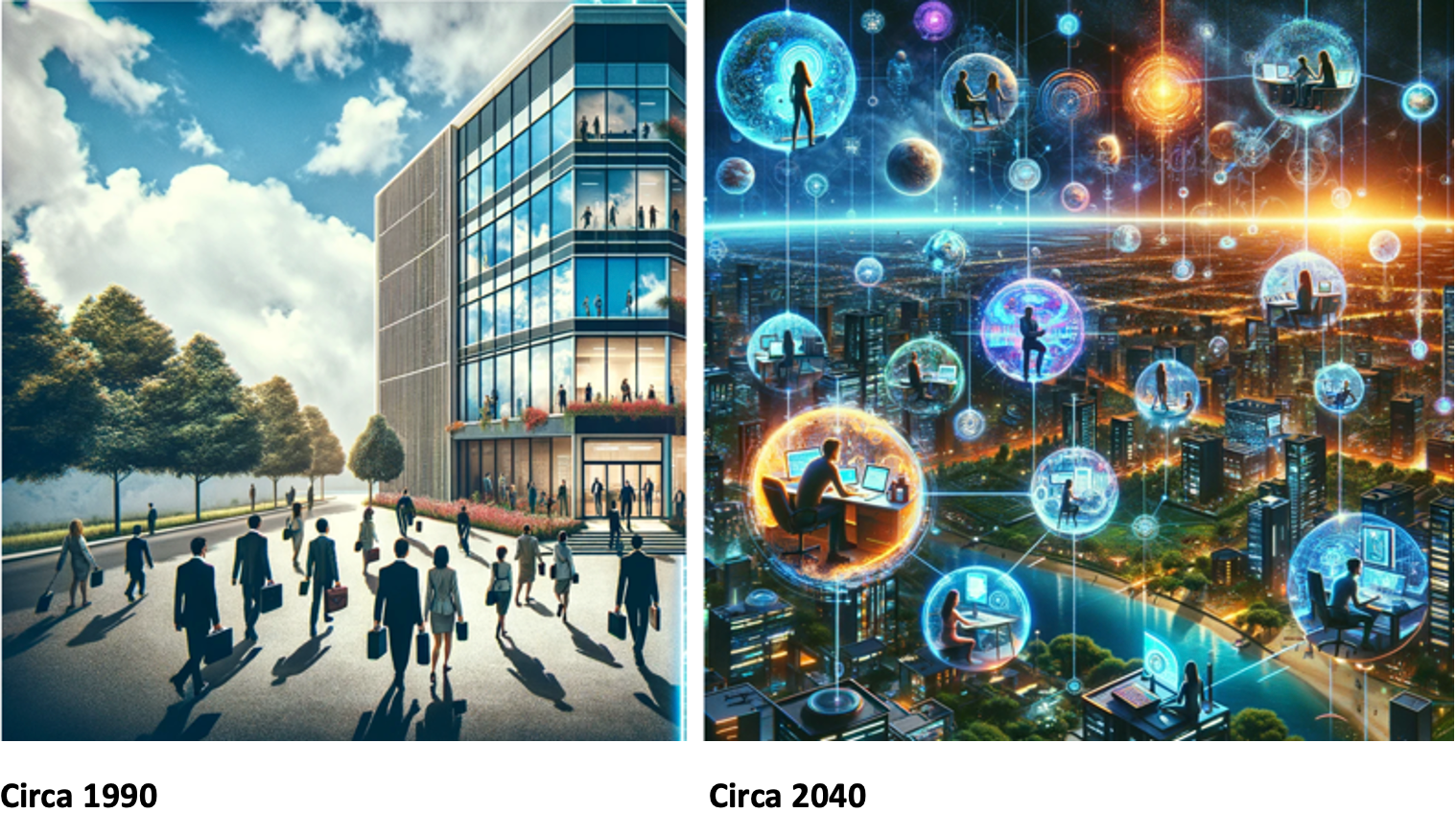
The following table demonstrates that APTT holds across all major eras of human work. The dimensions remain constant. The modes evolve.
| Dimension | Pre-Industrial | Industrial | Knowledge Era | Distributed/AI |
|---|---|---|---|---|
| Activities | Craft, agriculture, trade | Assembly, processing, supervision | Analysis, coordination, communication | AI-augmented creation, orchestration |
| Places | Field, workshop, market | Factory, office building | Corporate campus, home office | Anywhere, virtual, hybrid |
| Time | Seasonal, daylightbound | Shift-based, clockregulated | Business hours, early async | Asynchronous, global, elected |
| Technology | Hand tools, animal power, oral/written | Machines, telegraph, filing systems | Computers, email, digital networks | AI, cloud, zero-trust security |
In every era, work is describable by specifying what is being done, where it is happening, when it occurs, and how it is enabled. No era requires a fifth question. No era can be described without all four.
5. The Permanence Assertion
The APTT Framework makes a claim about the future: These four dimensions will remain valid regardless of technological change.
Quantum computing will change how work is enabled. It will not change the fact that work requires enablement.
Neural interfaces may change where work happens. They will not eliminate the dimension of place.
Artificial general intelligence may change what activities humans perform. It will not eliminate the question of what is being done.
The modes within each dimension will continue to evolve—as they always have. The dimensions themselves are permanent features of work as a human phenomenon.
This document asserts that the APTT Framework will remain valid in 2065, in 2125, and beyond—not because the modes will remain static, but because the questions are eternal.
6. What This Is Not
The APTT Framework is an ontology—a statement about what work is. It is not:
- A methodology — How to observe, measure, or improve work is a separate question.
- A value judgment — The framework does not assert what work should be, only what it is.
- A management tool — Applications built on this ontology may serve management purposes; the ontology itself is descriptive.
- A taxonomy of jobs — APTT describes work at the instance level, not the role level.
The value of a correct ontology is that it enables correct observation, correct measurement, and correct intervention. Without a definition of work, all workplace strategy is guesswork.
Appendix: 2025 Taxonomy
The following taxonomy represents the current modes within each dimension as of December 2025. This appendix is time-bound and expected to evolve. The dimensions are not.
The following taxonomy represents the current modes within each dimension as of December 2025. This appendix is time-bound and expected to evolve. The dimensions are not.
A.1 Activities
| Category | Sub-category | Description |
|---|---|---|
| Solitary | Cognitive focus | Concentrated individual work, analysis, creation |
| Shallow/administrative | Email, routine processing, low-cognitive tasks | |
| Internal Informal | Structured connection | Scheduled peer interactions, intentional relationship maintenance |
| Unstructured collisions | Serendipitous encounters, spontaneous exchanges | |
| Conflict resolution (peer) | Informal working-through between colleagues | |
| Internal Formal | Scheduled assembly | Coordination, communication, recognition (town halls, syncs, celebrations) |
| Emergent assembly | Incident response, urgent problem-solving, crisis coordination | |
| Managerial | 1:1 reviews, performance conversations, formal conflict resolution | |
| Brainstorming/ideation | Facilitated creative sessions | |
| External Informal | Existing relationships | Client maintenance, vendor coordination, partner check-ins |
| External Formal | Prospective commercial | Sales, new partnerships, business development |
| Developmental | Formal learning | Training, courses, certifications, compliance |
| Informal learning | Self-directed study, observation, experimentation | |
| Constructive access | Mentorship (up/down/lateral), coaching, developmental relationships | |
| Talent acquisition | Recruiting, interviewing, candidate socialization |
A.2 Places
| Category | Description |
|---|---|
| Core Facility | Primary employer-administered location (HQ, main office) |
| Distributed Facility | Secondary employer-administered locations (regional, branch, projectbased) |
| Dedicated External | Reserved space not run by employer (executive suite, dedicated coworking desk) |
| Flexible External | On-demand space not run by employer (drop-in coworking, day pass) |
| Home Workspace | Employee's own space configured for work |
| Incidental Location | Public/semi-public spaces used opportunistically (café, library, airport) |
| External Organization | Facilities of clients, vendors, partners, event venues |
| Mobile/Transit | Work while moving (train, plane, car) |
A. 3 Time
| Category | Description |
|---|---|
| Synchronicity | Synchronous (real-time) vs. Asynchronous (time-shifted) |
| Election | Observable patterns of when work actually occurs (time-of-day, day-ofweek) |
| Duration | Length and character of work sessions (bounded, extended, interrupted) |
| Rhythm | Pattern of work across longer horizons (continuous, burst, fragmented) |
| Temporal Distribution | Participants co-located in time vs. distributed across time zones |
A.4 Technology
| Category | Description |
|---|---|
| Communication | How participants exchange information (real-time, near-time, asynchronous; voice, video, text) |
| Collaboration | How participants work together on shared objects (co-creation, coordination, handoff) |
| Production | Tools for individual output creation (role-specific: design, code, analysis, writing) |
| Access | How work systems are reached (device, network, location independence) |
| Protection | How work and data are secured (authentication, encryption, permissioning, sequestration) |
7. Conclusion
Work is observable interaction across four dimensions: Activities, Places, Time, and Technology.
This definition holds across all eras of human history. It will hold across all eras to come. The modes evolve. The dimensions are permanent.
For the first time, work has a complete definition.
Last updated January 6, 2026